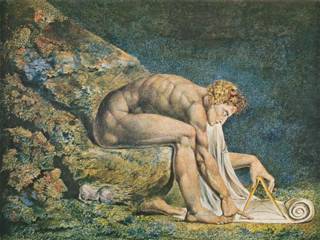
So, William Blake, great poet, visionary, "romantic", and social critic of sorts didn't much like Mr. Issac Newton. Not a very flattering portrait of him here, naked and rather inept looking, as he tries to ape the great geometer and create the world, or something. Just a man, a naked man, not a god, as some (Blake felt) would have it in his day. And he wrote:
Mock on, mock on, Voltaire, Rousseau;
Mock on, mock on; 'tis all in vain!
You throw the sand against the wind,
And the wind blows it back again.
And every sand becomes a gem
Reflected in the beams divine;
Blown back they blind the mocking eye,
But still in Israel's paths they shine.
The Atoms of Democritus
And Newton's Particles of Light
Are sands upon the Red Sea shore,
Where Israel's tents do shine so bright.
But Newton, arrogant, perhaps egomaniacal, though he was, knew what he didn't know. When asked to explain in detail what was the nature of Gravity he famously replied, "I do not frame hypotheses." [Hypothesi non fingo.] He knew Socrates' saying, "I know that I know nothing." He wasn't about to go into esoteric, unfounded, unnecessary, and mystical explanations of what seemed to his contemporaries to be an occult force acting at a distance. He just knew that his "laws" of gravity described everything very nicely indeed. And made quite accurate predictions possible as well. As to what Gravity is, well, he left that to philosophers. (And perhaps to those who enjoy parsing what the meaning of is is. A good question, if you ask me.)
Which brings me to my point here, that people who profess to be believers in God, and who insist that those who do not believe are daft, stupid, or simply missing the obvious, are people who don't know, or don't want to know what they don't know. Understanding the depths and extent of one's ignorance is a very important step towards knowledge. Our ancient forebears, when faced with phenomena they feared and could not explain, develped cults, magic, and eventually religions. These evolved into sophisticated cultural instruments that spawned complex ethical systems, artistic production, political dogmas and a lot of other stuff, but if you don't accept the basic God-premise, they are pretty much beside the point. Not that their content is worthless, but you might as well get to the same place by a different route if you don't accept that premise. And what does it come down to in the end...a refusal to accept ignorance, lack of knowledge. A fear of the void in our knowledge.
I have come to conclude that such believers share much more with the crude, reductionist, vulgar materialist, atheists they scorn and pity so much. Both types have an unshakeable need to answer all questions with a definite answer. (Thus the absurd contention by believers that atheism is just another religion, one that "worships" science. Well, sadly, that is true sometimes, for some people.) When faced with the Big Bang, the believer asks, quite reasonably, "But what created the Bang, what was before, wasn't there a little-bitty-something that started it all?" And if the rationalist says, "Well, we aren't sure right now, we don't know," the believer says, "Aha, see, that's God!" Better to leave what you don't know alone until you do know it.


No comments:
Post a Comment